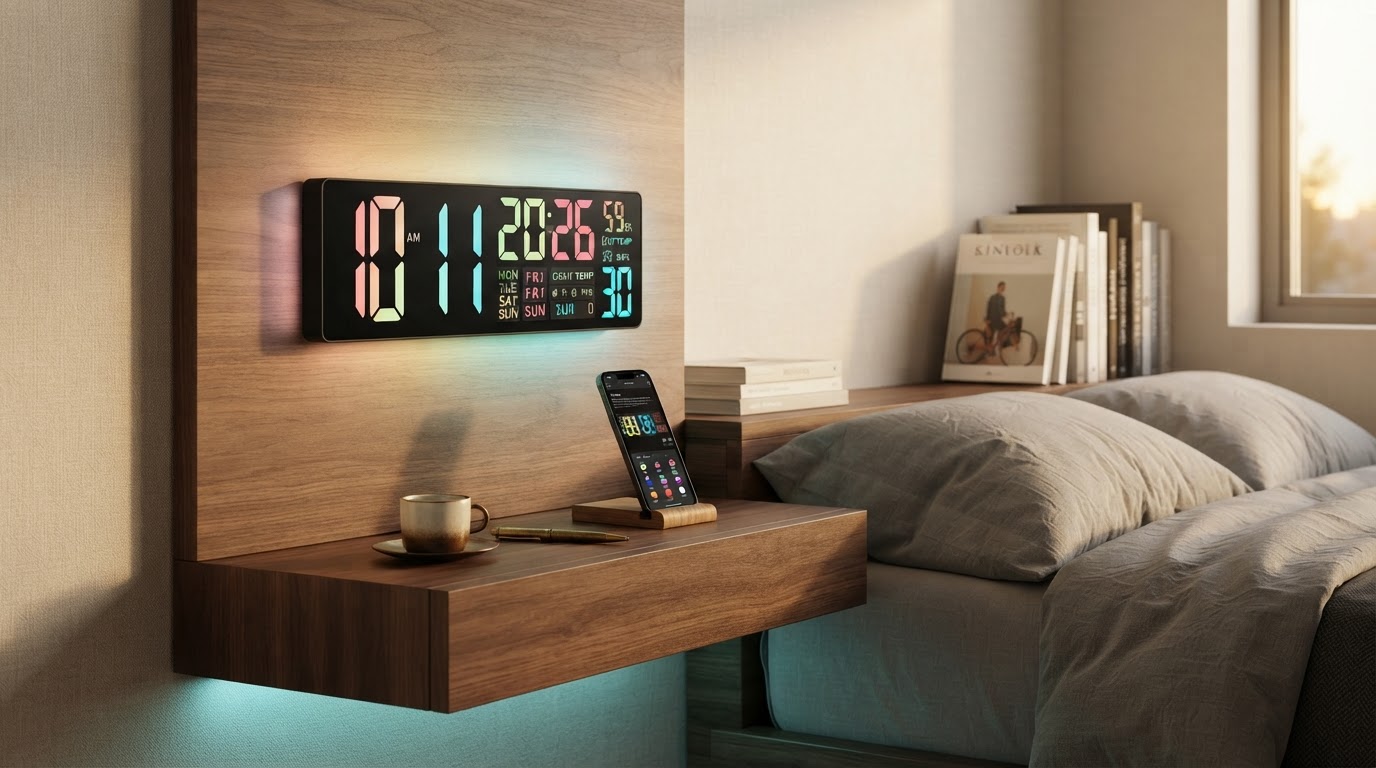
Smart RGB Clock Performance Standards
 Maya ChenContributing Editor
October 11, 2026 — The shift toward multi-functional bedside hardware has accelerated, placing the Smart RGB Clock at the center of a crowded market for networked timepieces. While the industry frequently prioritizes aesthetic gimmicks, the technical requirements for stable ambient lighting and data synchronization remain the true differentiators for modern consumers.
The conventional wisdom says that any LED panel with a Wi-Fi chip qualifies as a smart device, but this ignores the high failure rate of low-tier controllers found in generic alternatives. According to data from AliExpress, current market-entry devices now offer 16 million colors and four-level brightness settings ranging from 25% to 100%, yet these specs often mask poor software stability. The Smart RGB Clock aims to address these inconsistencies by grounding its visual output in a more robust firmware architecture that prevents the flickering common in unbranded units.
The Hardware Reliability Framework
Here’s the part nobody talks about: the longevity of an RGB display is dictated by its power management and heat dissipation, not its peak brightness. A standard Smart RGB Clock operates on a 5V/2A input, which is sufficient to drive high-density LED arrays without thermal throttling. In contrast, many curved or projection-style clocks found on eBay utilize lower-quality capacitors that degrade within 18 months of continuous use. When evaluating a customizable led alarm clock, the focus should remain on the refresh rate of the color transitions. A high-quality minimalist smart clock with weather must maintain a consistent 60Hz update frequency for its data readouts to remain legible during rapid color cycles. If the hardware lacks a dedicated real-time clock (RTC) battery backup, a simple power flicker renders the 'smart' connectivity useless until a manual reset occurs. Run the math: a device that requires three minutes of reconfiguration every time the power dips loses its utility faster than a traditional analog piece. The smart rgb clock app control guide highlights that true value is found in the [digital desk clock with app control](/blog/smart-rgb-clock-app-control-guide) ecosystem where settings are stored in the cloud rather than volatile local memory. For a clock to be viable in a modern workspace, it must sustain its primary function—accurate timekeeping—while simultaneously managing a high-bandwidth RGB controller.
Expert tip: Always verify if your smart clock supports 5GHz Wi-Fi bands; many budget models are restricted to 2.4GHz, which leads to significant latency during music synchronization or weather updates.
I’ll change my mind when manufacturers prioritize open-source firmware over proprietary apps that eventually lose server support. Until then, the hardware stability of a dedicated unit remains the only metric that matters.
Sources
- RGB Digital Alarm Clock Top 2 Best Smart Clocks Under Budget!
- Rgb Clock - eBay
- The Best Digital Wall Clock I've Ever Used! - - YouTube